
How to plan a meaningful funeral service
Five tips from a celebrant
When you’re planning a funeral, it can be very overwhelming, especially when you’re grieving. It can feel like a big responsibility. How do you craft a service that honours the life of the person who has died, and helps the people who will be there say goodbye?
If you’re worrying about how to plan a meaningful, personal funeral service for your person, here are some tips from a funeral celebrant.
The first thing to know is this - there is very little in a funeral service that is set in stone. People are often surprised by how flexible a service is, especially if it is not a religious service.
This doesn’t mean you have to start ‘from scratch’ - knowing what other people have chosen can be a helpful structure to get you started. But rather than thinking ‘what do people usually do?’, try asking yourself this question ‘what function is it serving?’
For instance, why do we often play music when the coffin is being carried in? Well, there are many reasons, but some of them would be:
A sign of respect for the moment when the person who has died is brought into the space
To signal the formal start of the service
To express something of the person’s personality, or what they meant to you, through your song choice.
With that said, here are a few ways to plan a service that will feel meaningful and personal to you:
1. Choose music that your person loved or that makes you think of them
It’s common for people to think you have to play ‘funeral music’ at a funeral. This could mean going with religious music (whether you or your person was religious or not), or choosing popular music that you’ve heard at other funerals. While there’s absiolutely nothing wrong with either of these, it’s worth knowing that you can have whatever music you like - whether or not it’s traditional ‘funeral music’. Was your person a huge fan of heavy metal? Play their favourite banger! Or were they a huge football fan? Team anthem it is!
2. Customise the flowers
Flowers can be a beautiful, respectful element of a funeral service. This doesn’t mean, however, that you have to go with traditional funeral flowers, such as a formal spray, or the traditional funeral lettered tributes. Maybe this is perfect for you - but you can also:
Pick your own flowers, or gather them from your garden.
Have a selection of succulents. These can be in separate pots that can be taken with you to decorate the wake venue, or for guests to take away as a memory of the service.
Go even more rogue - decorate their coffin with vegetables from their allotment, books from their library or simply placing their cricket bat atop the coffin.
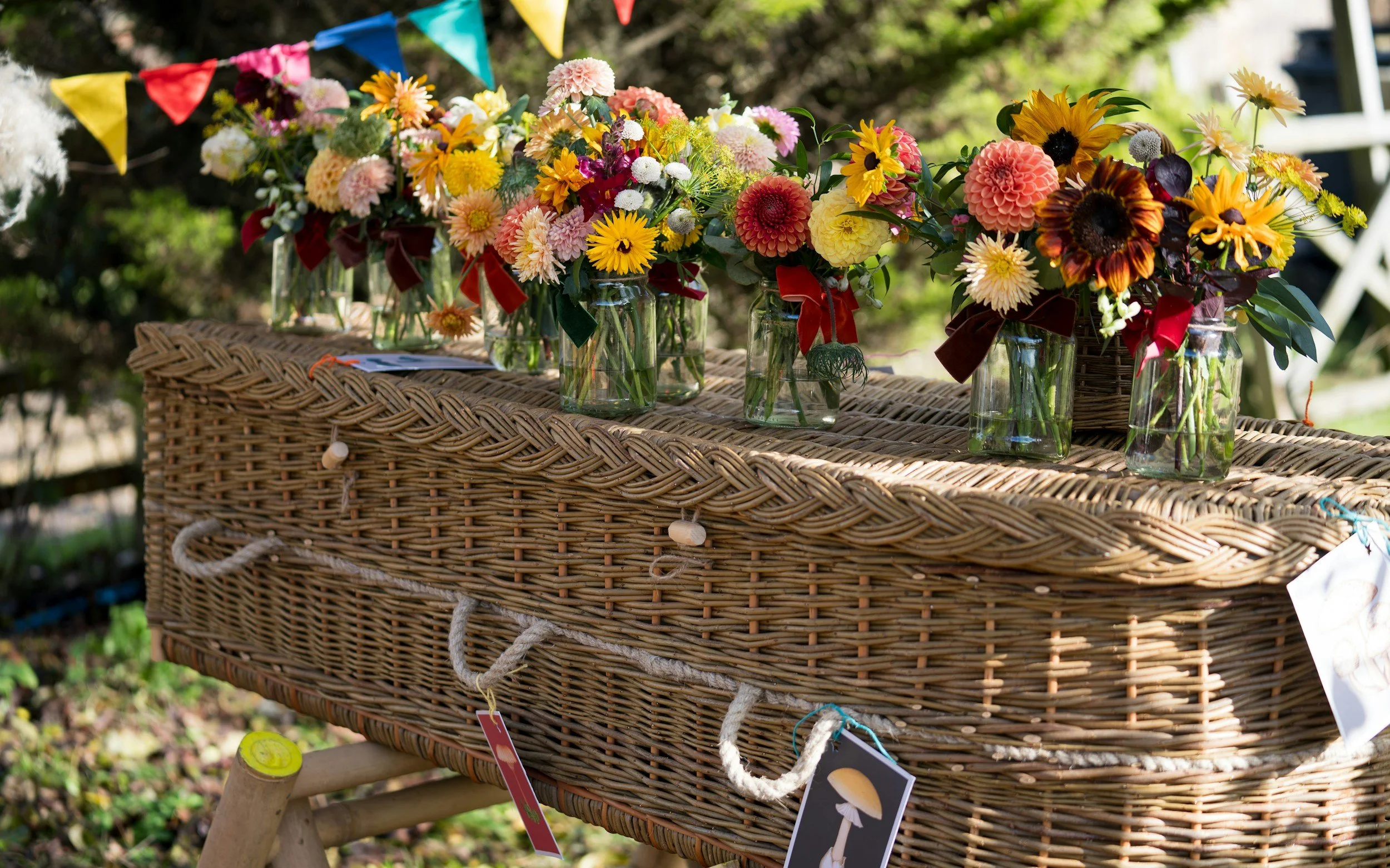
Image courtesy of the amazing team at Dead Good Legacies
3. Consider a symbolic act
Traditional funerals contain many rituals, such as prayer and hymns. These may not be quite right for everyone, but there are other rituals and symbolic acts that can help everyone present feel included and offer a profound moment of farewell or gratitude. Just a few examples include:
each person placing a flower or sprig of rosemary (the herb of remembrance) upon the coffin
inviting people to spontaneously share a memory or something they loved about the person
group singing - it isn’t just for hymns!
blowing bubbles. This can be very tender and beautiful at the funeral of a child or young person
When thinking about your person, something else might spring to mind. Don’t be afraid to give it a try. A funeral isn’t a performance, and things don’t have to go perfectly in order to be really special.
4. Don’t be afraid of laughter or silliness
A funeral doesn’t have to be sombre. In fact, moments of levity can help everyone relax a little and enrich the heartfelt moments. Laughter helps with the tears. If you know your person would absolutely have loved you to come up for your eulogy wearing a naughty cooking apron from your trip to Ibiza - do it!
5. Consider an alternative funeral venue
Many people don’t know that you don’t have to have a funeral service at the chapel at the crematorium or cemetery. You can have a service in a whole range of venues, from museums to pubs to boats! If a crematorium chapel just isn’t feeling right, talk to your funeral director about choosing something different.
6. Lastly - get professional support!
Of course, as a funeral celebrant in London, I’m going to say this - but get support to help you put together the service that is right for you.
Choose a funeral director that listens to what you want and helps you create something bespoke. Work with a celebrant who can help you build the service and hold the space for you on the day so you can relax a bit more and have the experience you deserve. Or, simply call in the support of your friends and family.
I hope this advice helps you in planning the funeral for your loved one. I’m wishing you all the best for the funeral and beyond.
Rev. Holly x
